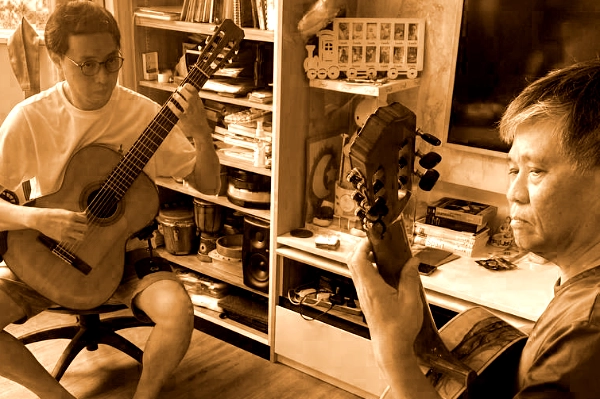
Andrew Wee is a Singaporean classical guitarist and teacher with a bit of Filipino flavor. He plays arrangements of Maestro Jose Valdez on a 10-string guitar, is Catholic, and likes Filipino food. All rare traits among our neighbors in Asia.
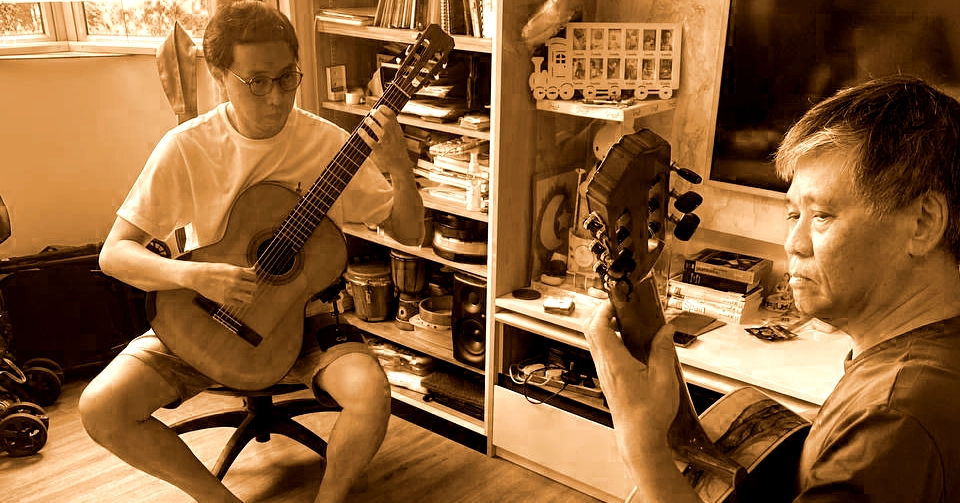
The interview began at Kai Juan Eating House, an old-school bak kut teh place in Balestier Road, Singapore, and continued in his home studio at Toa Payoh.
Not to be confused with the Filipino rap legend Andrew E., Andrew Wee is a Suzuki method pioneer for guitar in Singapore, heads Classical Guitar Community in Singapore, and is one of the conductors and teachers at the Toa Payoh Guitar Club. He has been contributing to classical guitar events and education initiatives in Singapore, and recently the Philippines.
What first drew you to the classical guitar?
My uncle, jazz lounge guitarist Peter Gonzales, is a Filipino-Singaporean who married my Chinese aunt. He played guitar at family gatherings, parties, and church feast days. Along with the Filipino choir at church accompanied by the guitar, these left a strong impression and drew me to the guitar from a young age.
Later, I enrolled in a classical guitar course when I was 15 years old. My first teacher was Maestro Ernest Kwok, to whom I'm immensely indebted. I studied with him for about 15 years. Later, I embraced Suzuki philosophy and studied Suzuki guitar pedagogy under the close tutelage of Suzuki guitar teacher trainer Zeah Riordan.
You've organized events like the 2025 Tagaytay Guitar Retreat and proposed the idea of a Guitar Marathon in the Philippines. What inspired these, and what were the results?
The retreat idea came from annual week-long guitar camps I had read about in the US, Europe, and New Zealand.
When I chanced upon the villa at Hotel Kimberly, Tagaytay in 2024, I realized it had all the elements for an ideal guitar retreat right under my nose. I thought, with the support of my network of Filipino guitar teachers, we could launch the first-ever classical guitar retreat for both our communities.
We had 35 participants, a mix of guitar players and non-guitar players. Evening concerts were intimate, effective, and cozy. People were truly absorbed in that relaxed and focused setting. The four-day event passed quickly, and the participants left hoping for more.
As for the guitar marathon, I got the idea after Australian guitarist Dr. Oliver Fartach told me about the success of "Guitarathon" in Adelaide. It was a long, open-format play-in where people could come and go freely, with a casual atmosphere and even a food truck outside. I adapted the concept and organized it successfully for the classical guitar community in Singapore in 2024 and 2025, then later worked with my friends Monching Carpio, Sir Greg Yu, and Sir Horacio Borromeo to organize it in Manila in June 2025. Around 70 to 80 people participated.
It seemed like a good idea to develop Philippines–Singapore guitar events, since there are no language barriers and both countries contribute to the growing enthusiasm around classical guitar.
What is the guitar community like in Singapore?
From my recollection in the late 1990s, my teacher Mr. Ernest Kwok would ask me to attend meetings of the Guitar Society in Singapore (now defunct). That's where I first met the community of our early guitar teachers, including the late Mr. Alex Abisheganaden, who many consider the father of classical guitar in Singapore. Mr. Alex studied with John Williams, taught classical guitar on national TV, introduced guitar ensembles in public schools, and actively promoted the instrument. Older guitarists can tell you more, but that was the beginning of classical guitar in Singapore.
Later on, from 2000 to 2013, we had about ten years of international guitar festivals and competitions in Singapore organized by Tomas Music Consultants. These events really elevated the instrument's presence. They featured some of the world's best classical guitarists, including Manuel Barrueco, Carlos Bonell, Thibault Cauvin, Shin-Ichi Fukuda, Jorge Morel, and Benjamin Verdery. The level of performance was impressive and exciting, creating tremendous energy around the guitar. I recall young Filipino guitarists were competitors at the festival. I remain very grateful to Tomas Music Consultants.
Currently, with support from fellow teachers, I lead the entity Classical Guitar Singapore. Our community organizes monthly or bimonthly events ranging from concerts and community play-ins to talks and overseas trips. This public community aims to bring enthusiasts from all walks of life together to enjoy, learn more, and network around the guitar.