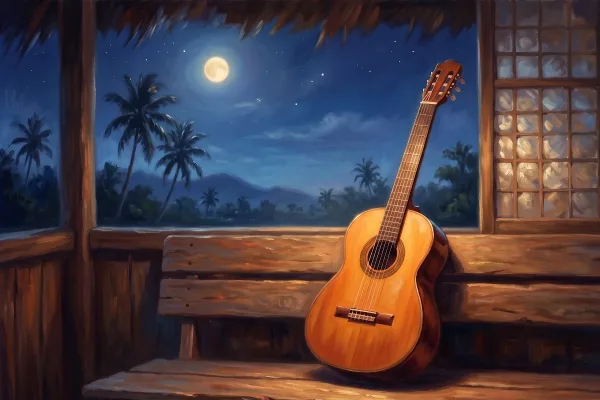
Filipino guitar music is one of Southeast Asia's richest and least-exported musical traditions. For more than a century the guitar has been the everyday instrument of the Philippines — the instrument of the evening serenade, the town fiesta, the church choir loft, and the family gathering. This guide is an introduction to that tradition: the major song forms, a little of the history, and where to find Filipino guitar sheet music if you want to play this repertoire yourself.
How the guitar became a Filipino instrument
The guitar arrived in the Philippines through more than three centuries of Spanish contact, but it did not stay a Spanish instrument. Filipino musicians absorbed it completely, building their own instruments, their own playing styles, and their own repertoire around it. By the late 19th century the guitar was central to Philippine musical life — and the country even developed distinct local guitar-making traditions of its own.
That history is a story in itself: the rise of the early five-string guitar in early Philippine music, and the long-running question of who really started the Philippine guitar industry — Cebu or Pampanga. Both are worth reading if you want to understand how deep the instrument's roots run here.
The kundiman: the Filipino art song
If any single form defines Filipino guitar music, it is the kundiman. The kundiman is a lyrical art song — traditionally in triple meter, moving from a melancholy minor opening to a warmer major resolution — that flourished in the late 1800s and early 1900s. Its lyrics are usually about love, but often carry a second, patriotic meaning beneath the surface: the beloved is also the homeland.
Composers like Francisco Santiago, Nicanor Abelardo, and Constancio de Guzmán gave the kundiman its classic shape, and the form translates beautifully to solo guitar and guitar ensemble. Its singing melodic lines and gentle harmonic motion are ideally suited to the instrument.
The harana: music of the serenade
Closely tied to the kundiman is the harana — the tradition of courtship serenade. A young man, often with a few friends and a guitar, would sing beneath the window of the woman he was courting. The harana was a whole social ritual with its own etiquette, and the guitar was its essential instrument. Many of the best-loved Filipino songs began life as harana repertoire, and they remain some of the most rewarding pieces to play on guitar.
Folk songs and dances
Beyond the parlor and the serenade, the Philippines has an enormous body of regional folk music — work songs, lullabies, courtship dances, and festival tunes, many in Tagalog, Cebuano, Ilocano, and other Philippine languages. Pieces like the fisherman's Bahay Kubo, the dance Pandanggo, and countless local melodies form a living folk repertoire that guitarists have arranged and passed down for generations.
Regional guitar styles are part of this picture too — including the distinctive kinablit fingerstyle tradition of the Cebuano-speaking Philippines, a reminder that "Filipino guitar" is not one style but many.
Patriotic music: Lupang Hinirang and Bayan Ko
The Philippines' patriotic repertoire is among the most searched-for Filipino guitar music of all. Two pieces stand above the rest:
- Lupang Hinirang — the national anthem, composed by Julián Felipe in 1898. If you want to play it, start with our guide to the chords and story of Lupang Hinirang on guitar, and see the full five-guitar ensemble arrangement.
- Bayan Ko — written during the American colonial period and later an anthem of protest and national feeling. See the Bayan Ko guitar arrangement.
Playing Filipino guitar music today
The challenge with this repertoire has always been access. Much of it lived in oral tradition, in performers' memories, or in out-of-print scores — hard to find and harder to read. That is exactly the gap The Philippine Guitar exists to close.
Every piece in our catalog is a professionally notated arrangement, credited to its composer and arranger, and delivered as an instant PDF you can print and perform — kundimans, harana favorites, folk songs, and patriotic anthems, arranged for solo guitar and guitar ensembles.
Whether you grew up with these songs or are discovering the Philippine guitar tradition for the first time, the best way to learn it is to play it.
Explore the catalog of Filipino guitar sheet music
Kundiman, harana, folk, and patriotic arrangements — instant PDF download.
Browse all arrangements →